
Why Does Pultec Still Feel “Magical”?
Plugin emulation A/B: UADx Pultec EQP-1A vs Waves PuigTec EQP-1A
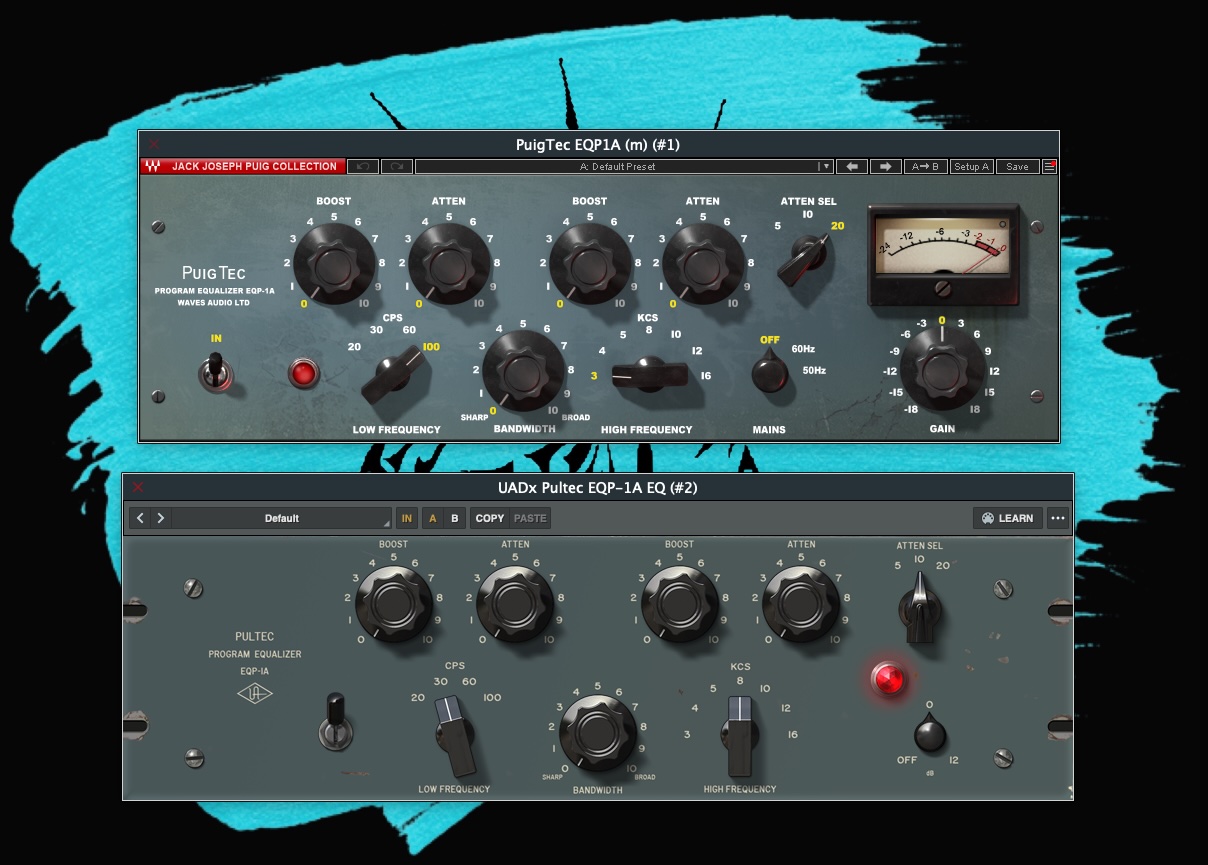
In the EQ world there are a few names that stay on top no matter how many new models come out. The Pultec EQP-1A is at the very top of that list. Designed in the 1950s as a “program equalizer,” it combines a passive EQ network with a tube make-up amplifier.
Even today you still hear people say things like “as soon as I put a Pultec on the bus, the mix widens, the low-end locks in and the top opens up.” There are a few reasons why that “magic” feeling persists:
- Passive network + tube make-up
The tone-shaping section is passive; even when you “boost,” you’re really working against attenuation curves, then recovering level with a tube make-up stage. That means you don’t just change frequency balance – you also introduce a bit of 2nd and 3rd order harmonic content. - Stacked curves that interact
On the low band, Boost and Atten are not the same control; they have different curves. The Boost tends to fatten slightly above the selected frequency, while Atten carves a bit higher up. Using both at once gives you solid subs with a tighter low-mid. That’s the classic “Pultec trick”: for example, 60 Hz with +4 Boost and 3–4 Atten on kick and bass. - Musical high-band behaviour
High Boost is a bell, High Atten is a shelf. Around 8–12 kHz you can use the Bandwidth control to either spread silky top-end or focus the presence. A touch of Atten at 10 or 20 kHz can tame harshness while keeping the sense of “air.”
In short, Pultec is not a surgical problem-solver; it’s a musical tone-shaper you reach for when you want the mix to grow, not just be “fixed.” Naturally, in the plugin world everyone has their own take on it. Here we’ll look at two of the most widely used versions: UADx Pultec EQP-1A and Waves PuigTec EQP-1A.
UADx Pultec EQP-1A: A Hardware-Faithful Modern Classic
Universal Audio has built a big part of its reputation on being “hardware-faithful” with classic analog gear. The UADx Pultec EQP-1A is based on both modern reissues from Pulse Techniques and carefully maintained vintage units.
Character
- Low-end
At 20/30/60/100 Hz the low-end feels tight and controlled. As you push the Boost, the bass doesn’t just bloat; it fills out from the bottom up without spilling too much into the low-mid. On kick + bass combos this helps you build weight without phasey, undefined mud. - Midrange
There’s no dedicated mid band on an EQP-1A, but the filters still shape mids quite a bit. On the UADx version the midrange tends to stay clean, punchy and well defined. On bass guitar and vocals you get a solid body that doesn’t turn into low-mid fog; it clears space while still carrying important mid-information. - Top-end
High Boost around 8–12 kHz is very smooth. Even on slightly sibilant vocals you can often push 3–4 dB without the top getting nasty. Combined with Atten at 10 or 20 kHz you can keep transients intact while shaving off harsh upper-mids. - Harmonics and drive
Even with flat EQ settings, simply inserting the plugin often gives you a subtle level lift and a sense of warmth. Because the tube make-up stage is modeled, pushing your gain staging a bit hotter gives you gentle saturation that feels classy rather than crunchy.
Technical notes and workflow
- Gain staging: The original Pultec already adds a little gain by design. The UADx behaves the same way, so it’s worth keeping the input under control and matching output level when you A/B. Especially on the mix bus this makes your decisions much more objective.
- CPU and stability: Now that it runs natively (UADx), it’s not quite as light as some Waves plugins, but on a modern Mac it’s safe to park on your mix bus and a few key channels without stress. Let your surgical EQs handle problem-solving in other inserts and keep the Pultec for tone-shaping.
Waves PuigTec EQP-1A: Puig’s Colorful Pultec
On the Waves side we get a model taken from Jack Joseph Puig’s personal pair of Pultecs. So on paper it’s the same EQP-1A design, but sonically it’s more like a snapshot of a specific, heavily used piece of hardware living in a real-world mix room.
Character
- Low-end
When you boost lows, PuigTec doesn’t just push the subs – it audibly fills the low-mid area as well. In the right context this gives you gorgeous weight and warmth; in the wrong context it can get a bit boxy or boomy. With 60 Hz boosts you can clearly hear 120–200 Hz react too. - Midrange
Compared to UADx, the midrange is softer and sometimes a bit “mushy.” Transients are slightly rounded off, and elements tend to glue together. For hip-hop vocals or lo-fi / indie productions this “stickiness” can be a vibe rather than a problem. - Top-end
High Boost has a more “grainy” and gritty texture. That can be a blessing or a curse: on clean pop vocals it may push sibilance, but on rock vocals, rap, or distorted lead guitars it can add attitude that feels very appropriate. - Harmonics and level
Just inserting PuigTec often results in a little extra level and noticeably more THD. Its drive character is more obvious than UADx, which is why it often feels like “you slap it on and things instantly warm up.”
Extra controls and details
- GAIN knob: Used both for level compensation and deliberate drive. It controls the overall output level of the plugin.
- MAINS (Off / 50 / 60 Hz): Models the original unit’s power-supply-related noise floor and hum. Off is the cleanest option; at 50/60 Hz you get a very low-level hum and analog noise plus tiny tonal shifts. It’s subtle, but you can hear a difference on very exposed material and quiet passages.
- CPU and practicality: Extremely light on CPU, so you can comfortably sprinkle it across many channels in large sessions. In the Waves ecosystem it has been stable and “safe” for years.
Head-To-Head: Low-End, Midrange, Air
Low-end
Example setting: 60 Hz, Boost 4, Atten 3
- UADx: Low frequencies swell in a controlled way. Sub information is strong, while 120–200 Hz stays relatively tidy. The kick remains punchy and retains its attack.
- PuigTec: Feels thicker. Lows extend into the low-mid more, giving the sense of extra weight. Depending on the arrangement this reads as “vintage heft” or as something you need to tame with additional EQ.
For sub-heavy material and 808-driven tracks, minimal moves with PuigTec can give you great club weight. For denser, guitar-driven mixes the tighter low-end of UADx often makes it easier to keep everything under control.
Midrange
- UADx: Midrange stays articulate and controlled. Bass, piano and lead vocals preserve clarity, and a slight low-mid tilt helps keep the mix bus from turning cloudy.
- PuigTec: Midrange is more “soft focus” and generally fuller. This is great for taming harsh upper-mids, but it can reduce overall definition in the stereo field. For that reason it often shines on parallel chains rather than being the only tone-shaper on a critical element.
Air & top-end
- UADx: Top-end is silky. As long as sibilance is somewhat under control you can push 4–5 dB of boost and still keep things hi-fi. Combining with a touch of Atten around 10 kHz lets you keep the air while gently shaving harshness.
- PuigTec: The high boost is more forward and grainy. On rap and rock vocals this extra edge can be exactly what you want; on bright pop vocals it can push “sss” and “tch” into uncomfortable territory unless you de-ess carefully.
Which One, When?
Every mix is different, but if I had to extract a rough decision-making guide from my own work, it would look like this:
Vocals
- Clean, modern pop / R&B / singer-songwriter vocals
- If you want some body and some air with minimal distortion, reach for UADx Pultec.
- A touch of Atten around 100 Hz plus a gentle 8–12 kHz boost (with Bandwidth tuned to taste) gives you a vocal that’s full and bright but still hi-fi.
- Rap, rock, lo-fi / indie vocals
- If you want grit, midrange glue and character, PuigTec tends to win.
- Slightly driving the plugin in the signal chain and using a more aggressive boost around 8–10 kHz can give these styles the attitude they often need.
Bass & kick
- Modern, tight low-end (metal, modern rock, EDM)
- UADx: The classic 60 Hz Pultec trick lets you boost sub and clean up low-mid at the same time. It also plays nicely with side-chain setups where you want consistent, controlled movement.
- Vintage, thick and weighty lows (classic rock, soul, boom-bap)
- PuigTec: Its low-mid-filling character can be perfect for sparser arrangements. On trap beats where the 808 and kick carry the track, PuigTec’s extra weight can sound great on club systems.
Guitar, piano, synth
- Acoustic / clean guitars, piano, pads
- For a more transparent touch that widens the image without smearing it, UADx is usually the safer option.
- Dirty guitars, crunch bass, character synths
- If you want a bit of saturation and midrange glue, PuigTec can bring the attitude those sources need.
Mix bus / master bus
- Mastering-oriented, controlled Pultec flavour
- UADx feels safer here. A gentle shelf around 30 Hz and a tiny air boost at 10–12 kHz helps the mix gel without radically shifting tonal balance.
- Characterful, vintage-flavoured mix bus
- PuigTec is bolder. As a rule of thumb, staying within 1–2 dB of boost/cut and, when in doubt, using it on a parallel bus (with some dry/wet blending) keeps things musical and under control.

Measurement Note: Different Characters Even with Matching Curves
In the graph above you see UADx Pultec EQP-1A (red curve) and Waves PuigTec EQP-1A (white curve) measured in Plugin Doctor. Here I tweaked both plugins by hand to arrive at a very similar overall frequency curve, rather than using identical knob positions. Even in this “matched” scenario, some meaningful differences remain.
In the low range (roughly 20–200 Hz), the red curve sits slightly above the white one across the whole plateau. That means that, for this particular setting, UADx is pushing the low-end just a bit harder than Waves. The difference is only about 0.3–0.5 dB, but because it spans a wide band, it translates into UADx feeling a touch more eager and full, while Waves sounds a bit more restrained at the same perceived tilt.
Moving up into the low-mid region (around 400 Hz – 1.5 kHz), the curves start to diverge: the red line drops off faster and ends up slightly lower at the dip. In other words, UADx is carving the upper low / low-mid region more than PuigTec, whereas Waves leaves a bit more information in that area. Subjectively, this reads as UADx giving you stronger bass with a somewhat cleaner low-mid, while Waves keeps a bit more “chest” and density there.
Around the classic mid dip (2–4 kHz) the red curve still stays below the white one, which makes UADx the more “smiley-shaped” EQ in this particular comparison. Both the low-mid and 2–4 kHz area are pulled back a little more on UADx, giving you that familiar “lows and highs open, center slightly scooped” feeling. The white curve (Waves) doesn’t dig quite as deep here, so PuigTec preserves a slightly fuller, more forward midrange.
In the presence region (roughly 5–10 kHz), the roles flip: now the white curve peaks a bit higher than the red one. That means in this band PuigTec is pushing presence slightly more than UADx. The UADx peak is a bit more modest, and feels more “hi-fi” and controlled; PuigTec’s presence rise reads as a bit more aggressive and in-your-face. Above about 15 kHz the curves almost completely overlap again – the real differences live in the lows, low-mids and presence band, not in the far “air” region.
In summary, even when you carefully tweak the controls to arrive at nearly the same curve, the two Pultec emulations still distribute energy differently: how much true low-end they give you, how much low-mid they let you keep, and how assertive 5–10 kHz feels. In this graph UADx (red) comes across as a slightly more “smiley” and sub-weighted voicing, while Waves (white) keeps a bit more mid and presence intact. On paper these are just fractions of a dB, but across wide bands they translate into clear tonal personalities: “UADx a bit more sculpted and hi-fi, PuigTec a bit fuller and more presence-forward.”
Conclusion: If You Own Both, Why You Should Keep Both
On paper you could say “these are just two emulations of the same EQ,” but in practice UADx Pultec EQP-1A and Waves PuigTec EQP-1A are not redundant – they’re complementary tools.
- UADx represents hardware-faithful tone, clarity and a modern, master-ready sound. It’s a reliable choice for mix bus work, mastering, clean pop vocals and tight, controlled low-end.
- PuigTec leans into character, dirt and personality. It often shines on hip-hop, trap, lo-fi, indie and vintage-flavoured rock where the mix benefits from extra attitude rather than maximum cleanliness.
In my own workflow, both have a clear place:
- On critical elements (lead vocal, bass, mix bus) I usually start with UADx to establish the main tonal backbone.
- Then I bring in PuigTec on parallel chains or specific tracks where I want added color and glue.
- Sometimes I even chain them on the same channel – UADx to “shape,” PuigTec to “dirty it up” – for a hybrid Pultec flavour that neither plugin can achieve alone.
So the real question is not “Can a single Pultec plugin handle all my mixes?”
The answer is yes, it probably can. But the spirit of Pultec has never been about “one correct setting.” It has always been about turning the knobs until it feels right. Extending that philosophy to plugin choice, keeping both UADx and PuigTec around simply gives you a wider, more expressive tonal palette to play with.